
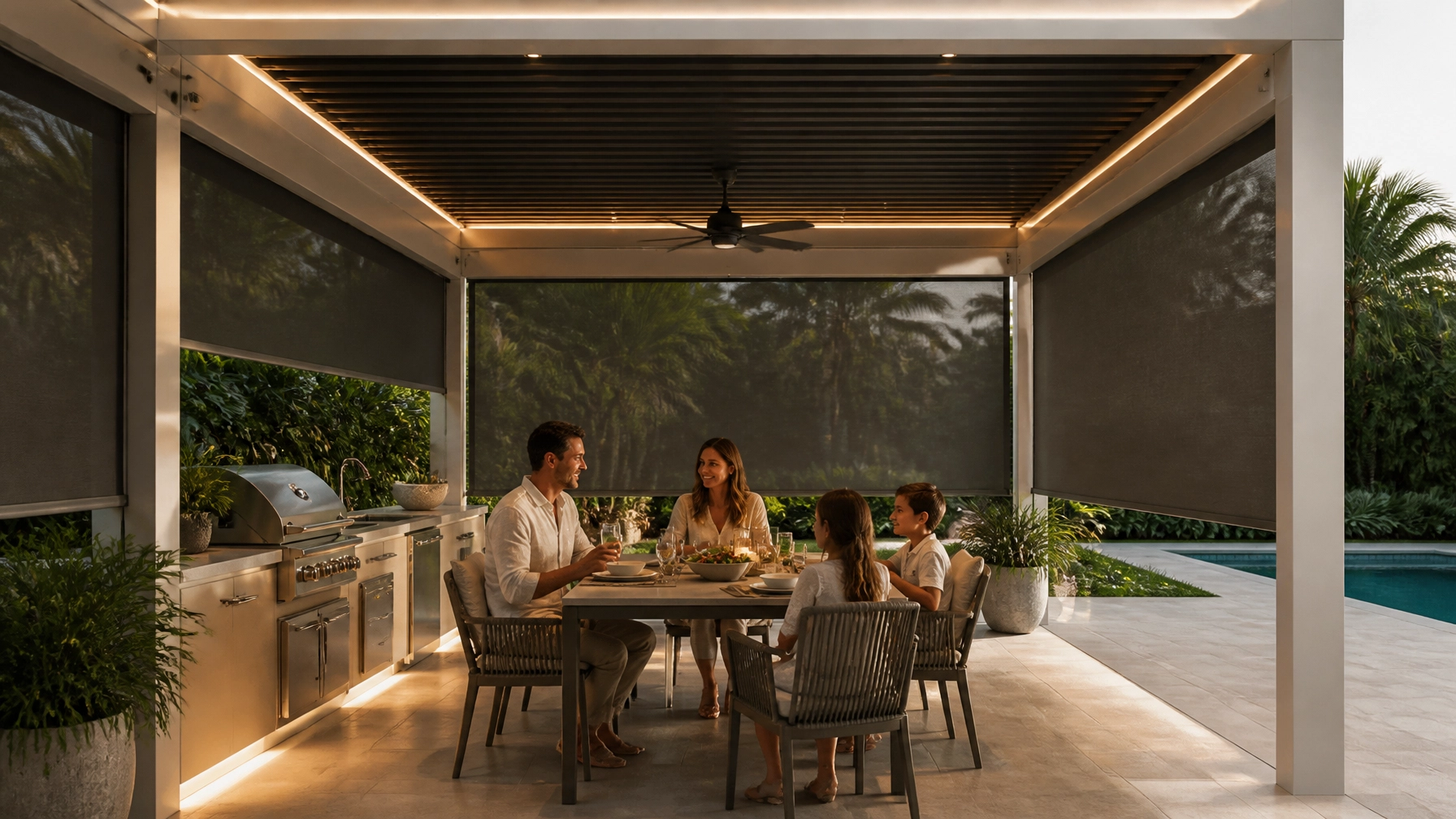
Dreaming of an outdoor living space that feels comfortable in bright sun, sudden rain, and everything in between? In South Florida, creating that kind of retreat requires more than beautiful furniture and landscaping. It requires a thoughtful approach to shade, airflow, privacy, insects, and changing weather conditions.
Two technologies make the transformation possible: the Motorized Louvered Roof and Motorized Patio Screens.
Each solves a different problem. Together, they can turn an underused patio into a luxurious outdoor room for entertaining, family time, outdoor dining, and everyday relaxation. But if you are planning your project in phases, which should you install first?
For most open patios, the answer is clear: start with the Motorized Louvered Roof. It creates the structure, defines the footprint, and gives your outdoor room its essential ceiling. The screens come next as the finishing layer.
What a Motorized Louvered Roof Does, and Why It Is the Backbone
Picture a serene oasis where you can control the atmosphere with the touch of a button.
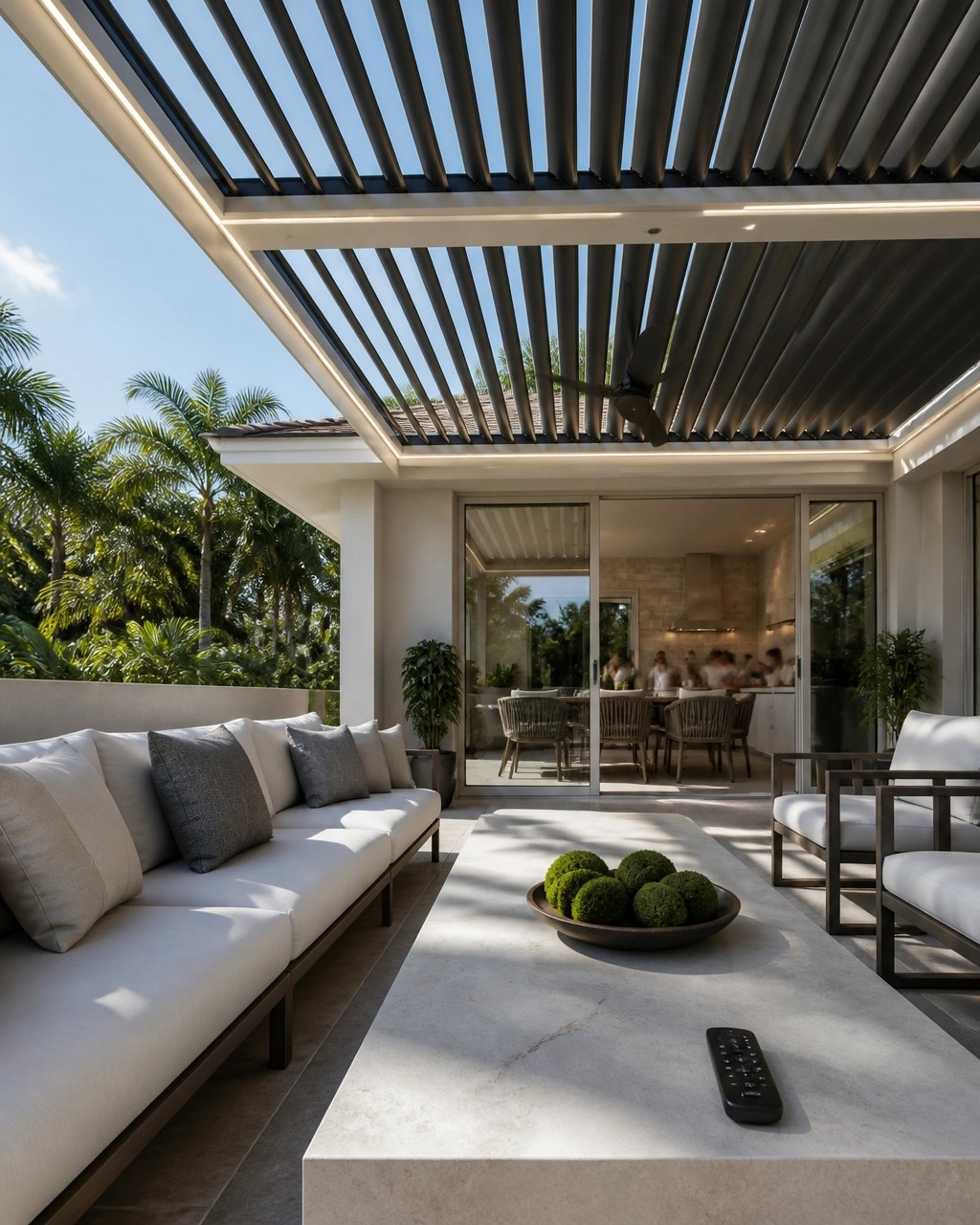
A Motorized Louvered Roof uses adjustable aluminum louvers that rotate up to 150 degrees. Open the louvers to welcome sunlight and fresh air. Angle them to create comfortable shade while maintaining ventilation. Close them when rain approaches and allow the overlapping louvers, integrated gaskets, gutters, and downspouts to shed water away from the space.
This is a major evolution from a fixed patio cover. Instead of accepting whatever conditions the day brings, you can adjust your outdoor environment in real time.
A premium system can include:
- Insulated double-skin louvers that provide a stronger, more comfortable roof assembly
- Remote control and smartphone app operation
- Rain and wind sensor integration
- Integrated LED lighting
- Concealed gutters and downspouts
- Compatibility with ceiling fans, heaters, audio, and other outdoor amenities
- Custom sizing and engineering for your property and local wind requirements
The roof is more than a shade product. It is the architectural foundation of your outdoor living space.
During a bright afternoon, angled louvers help reduce direct heat and glare. During an evening dinner, integrated LED lighting creates a warm, polished atmosphere. When a rain shower appears, you can close the roof without gathering cushions or rushing indoors.
A properly designed louvered system also gives you a stronger starting point for future improvements. Its beams and posts establish the locations for screens, lighting, electrical connections, fans, and outdoor kitchen elements. That makes the entire project feel seamless rather than added together piece by piece.
Explore Jupiter Pergola’s Motorized Louvered Pergolas.
What Motorized Patio Screens Do, and Why They Are the Perfect Partner
Ready to make your patio feel even more private and comfortable?
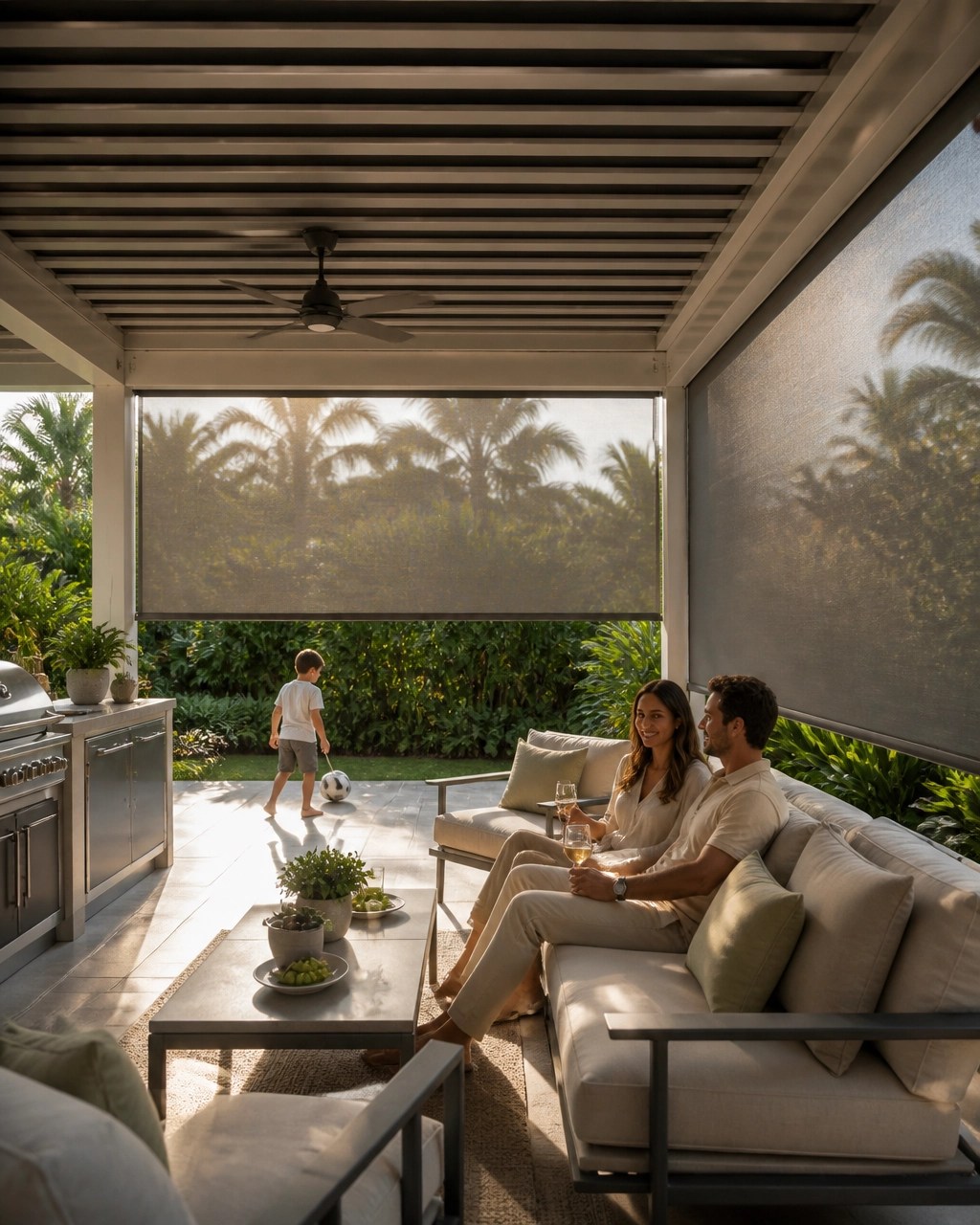
Motorized Patio Screens act as the walls of your outdoor room. Custom-fitted and retractable, they lower at the touch of a button and disappear into discreet housings when you want to restore the open-air experience.
Their benefits are especially valuable in the South Florida climate:
- Block low-angle sunlight and afternoon glare
- Reduce heat and UV exposure along the sides of the patio
- Keep insects out while maintaining airflow
- Add privacy when your patio faces a neighboring property
- Buffer light wind and wind-driven rain
- Help protect outdoor furnishings, electronics, and kitchen areas from direct salt air and airborne debris
- Create a more comfortable environment for dining, conversations, and evening gatherings
The right screen fabric can be selected for the way you use each side of the structure. An open-weave solar mesh may preserve views while reducing glare. A denser fabric can provide additional privacy. Different exposures may call for different screen specifications, particularly on a west-facing side that receives intense afternoon sun.
The simplest way to understand the relationship is this:
The Motorized Louvered Roof is the ceiling. Motorized Patio Screens are the walls.
On their own, screens cannot solve overhead heat and rain. A roof cannot stop mosquitoes, side glare, or privacy concerns. Together, they create a flexible outdoor room that can open fully to the landscape or become a more protected retreat in seconds.
Learn more about Motorized Retractable Screens.
Motorized Louvered Roof vs. Motorized Patio Screens: A Quick Comparison
| Feature | Motorized Louvered Roof | Motorized Patio Screens |
|---|---|---|
| Primary job | Controls sun, shade, airflow, and rain from above | Controls insects, privacy, glare, and side exposure |
| Best for | Overhead heat, changing weather, and defining an outdoor room | Mosquitoes, low-angle sun, wind, privacy, and wind-driven rain |
| Smart integration | Remote, app, and rain-wind sensor options | Remote, app, and coordinated controls |
| Structural role | Creates the primary framework and roof | Adds a custom-fitted enclosure layer |
| Installed first? | Yes, for an open patio; it anchors the structure | After the roof frame is complete, or alongside the roof during one project |
The Smart Order for a Phased Project
1. Start with a lifestyle-driven vision
Before choosing a product, consider how you want to live outdoors.
Will your new space host weekend dinners, poolside celebrations, family breakfasts, or quiet evenings with a book? Do you want an outdoor kitchen, television, ceiling fans, integrated lighting, or a dedicated dining area?
Your answers help determine the ideal footprint, roof orientation, screen locations, electrical plan, and level of privacy. The most successful patio enclosure ideas begin with the experience: not a catalog of parts.
2. Design and install the roof first
If your patio is currently open, the Motorized Louvered Roof should generally be the first installation.
It defines the structure and gives every future feature a logical place to connect. The roof supports the screen housings and tracks, establishes drainage, and creates a finished frame for lighting, fans, speakers, and other amenities.
This is also where engineering matters most. South Florida structures must account for intense sun, humidity, salt air, heavy rain, and hurricane conditions. Generic, off-the-shelf products may look attractive in a photo, but they are not necessarily designed for the wind loads and site conditions at your address.
Jupiter Pergola projects are designed, engineered, fabricated, and installed in-house. That integrated process gives you greater control over quality, communication, detailing, and the final result.
For more information about hurricane-conscious design, review our guide to pergolas and hurricane season in South Florida.
3. Plan the screens from day one
Even if your budget calls for a phased installation, plan the Motorized Patio Screens while designing the roof.
This allows your contractor to account for screen cassettes, structural clearances, wiring, control systems, and finished dimensions before fabrication begins. When screens are designed into the structure from the start, the result is cleaner and more architectural. The housings can be integrated into the beam lines, and the tracks can align naturally with the posts.
Screens can sometimes be added later, but planning ahead helps prevent visible retrofits, unnecessary electrical work, or compromises in the final fit.
4. Layer in the luxuries
Once the roof and screen strategy is established, you can add the details that make your outdoor living space extraordinary.
Consider:
- Integrated LED lighting for entertaining after sunset
- Ceiling fans for increased airflow
- An outdoor kitchen or built-in grill
- A television or outdoor audio system
- Comfortable dining and lounge furniture
- Privacy walls, planters, and tailored landscaping
- Heating elements for cooler evenings
These features are not merely decorative. They support the way you want to use the space: whether you are hosting friends, sharing a meal with family, or enjoying a quiet morning outside.
5. Choose a licensed and insured contractor
A luxury installation deserves professional accountability from concept to completion.
Look for a contractor who understands local permitting, site-specific engineering, electrical requirements, and South Florida wind conditions. Jupiter Pergola holds both General Contractor and Electrical Contractor licenses: Florida CGC1530171 and EC13012123: so the structural work, motorized systems, lighting, and electrical components can be managed through one qualified team.
A reputable contractor should be able to explain how the structure is engineered for applicable wind loads, how it will be anchored, how drainage will work, and what maintenance the finished system requires. This attention to detail is what separates a truly custom project from a generic installation.
The Verdict: Install the Motorized Louvered Roof First
For an open patio, install the Motorized Louvered Roof first.
It is the anchor. It establishes the footprint, creates overhead comfort, provides a rain-shedding roof, and offers the structural framework needed for lighting, drainage, screens, and other enhancements. Once the frame is complete, Motorized Patio Screens can be custom-fitted as the finishing layer.
The best systems can integrate both technologies into a single remote or app, allowing you to adjust the louvers and deploy the screens together. Open everything for a morning breeze. Angle the roof and lower one screen against afternoon glare. Close the system for a more private evening gathering.
If your patio already has a suitable, structurally sound roof, the priority may shift to screens. But when you are transforming an open backyard from the ground up, the roof should lead the design.

Dream With Us
Your backyard can be more than an ordinary outdoor area. It can become a bold, serene extension of your home: a lifestyle-oriented retreat designed around comfort, functionality, and style.
At Jupiter Pergola, we manage every detail in-house, from the initial design concept through engineering, fabrication, permitting, electrical work, and final installation. We create custom outdoor living spaces that respond to your vision and the realities of the South Florida climate.
One button can change the shade. Another can bring down the screens. But the real transformation is how often you choose to stay outside.
Dream with us. Request a consultation with Jupiter Pergola and let’s make your vision a reality.
Important weather-resistant design note: Shade structures are engineered to be weather resistant, providing protection from sun and rain in typical conditions. They are not sealed envelopes like a house and are not intended to be fully watertight or airtight structures. Wind-driven rain, misting, splashing, or occasional drips may occur during severe conditions.