
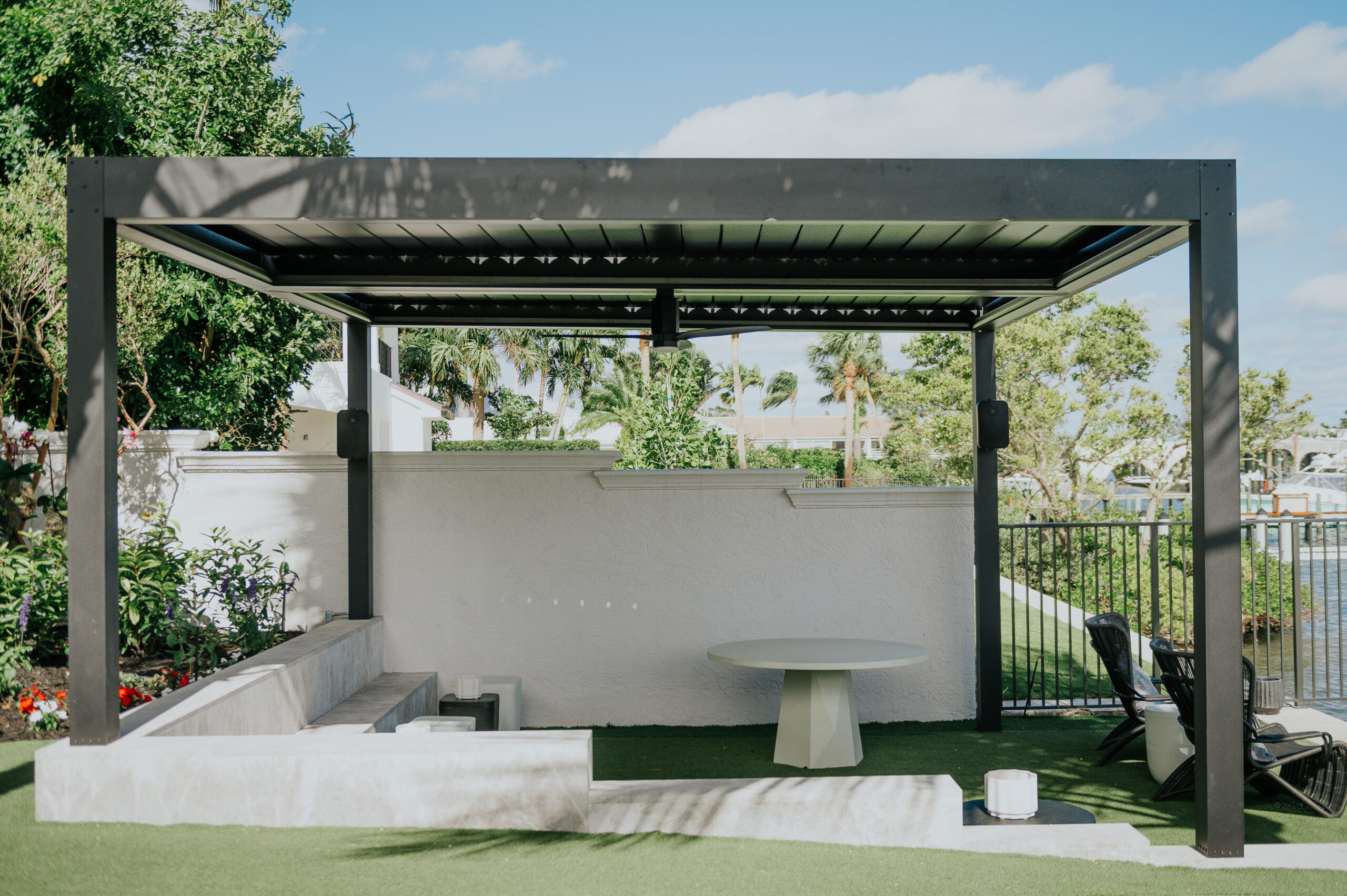
Ask five neighbors in Jupiter what they call the shade structure in their backyard and you might get five different answers. Pergola, gazebo, cabana — the terms get used interchangeably, but they describe three different structures with different strengths. If you’re planning an outdoor living project in Palm Beach, Martin, or St. Lucie County, knowing which one actually fits your yard, your habits, and our South Florida weather will save you from an expensive mismatch.

Here’s a plain-English breakdown of how the three compare — and the questions to ask before you commit to any of them.
What Counts as a Pergola, a Gazebo, and a Cabana?
A pergola is an open structure with posts supporting a roof of beams, slats, or — in modern versions — motorized louvers. It’s usually attached to the house or anchored over a patio or pool deck, and its defining trait is flexibility: it filters light rather than blocking it entirely, unless you choose a louvered roof that can do both.
A gazebo is a freestanding structure with a solid, permanent roof, traditionally octagonal or square, often placed away from the house as a destination in the yard. Think of it as a room without walls: full overhead protection, fixed in place.
A cabana sits closest to a true outdoor room. Usually positioned poolside, it combines a solid roof with at least partial walls, curtains, or screens, giving you privacy and a place to change, lounge, or escape the sun completely. Many of the cabanas we build in South Florida include ceiling fans, lighting, and space for an outdoor kitchen or bar.

How Each One Handles South Florida Weather
This is where the decision gets real. Our climate is the toughest test any outdoor structure will face: intense summer sun, afternoon downpours that arrive with little warning, salt air near the coast, and hurricane season from June through November.
- Sun: A traditional slatted pergola softens sunlight but doesn’t eliminate it. A gazebo or cabana blocks it completely — all the time, even on the winter days when you’d love some warmth. A motorized louvered pergola is the only option that lets you choose, opening for sun and closing for full shade at the touch of a button.
- Rain: Gazebos and cabanas win here by default with their solid roofs. An open pergola offers little rain protection on its own, but a louvered pergola with an integrated gutter system sheds rain like a solid roof when closed — which matters when a storm rolls in halfway through dinner.
- Wind: Any structure in South Florida should be engineered for our wind loads and properly anchored, period. Freestanding gazebos with large solid roofs catch significant wind, so their footings and framing need to be designed accordingly. Modern aluminum pergolas engineered for coastal wind zones tend to handle this well, and louvers can be opened to let wind pass through rather than push against a solid surface.
- Salt and humidity: Wood structures of any type demand constant maintenance near the coast. Powder-coated aluminum resists corrosion, doesn’t rot, and won’t feed termites — one reason it has become the default material for high-end outdoor structures in our area.
Match the Structure to How You’ll Actually Use It
Weather aside, the best choice comes down to honest answers about how you live outside. A few scenarios we see often:
- You entertain on the patio and want to extend the house outward. A pergola attached to the home is the natural fit. It keeps the flow between kitchen and patio seamless and can shelter dining, lounging, and grilling zones under one roofline.
- You want a destination in the yard — a spot for morning coffee away from the house. That’s the classic gazebo role. It draws people out into the landscape and anchors a garden or lakeside view.
- Your life revolves around the pool. A cabana earns its keep every weekend: shade for the kids, a place for guests to change, storage for towels and floats, and a bar or TV wall if you want one.
- You want one structure that does nearly everything. A motorized louvered pergola covers the widest range — open for sun, closed for rain, and pairable with retractable screens or glass walls if you later decide to enclose the space.
Think About What Comes Next, Not Just What Comes First
One mistake we see homeowners make is choosing a structure for today’s needs without considering how the space might evolve. The family that starts with simple shade often wants a fan and lighting within a year, then screens to deal with evening mosquitoes, then maybe frameless sliding glass to make the room usable during a July thunderstorm. A gazebo or a basic wood pergola boxes you in; a well-built aluminum pergola is designed to accept those upgrades later without starting over.
Permitting is the other planning item people overlook. In Palm Beach County and neighboring counties, permanent shade structures generally require permits and engineering documents, and the requirements differ between attached and freestanding designs. Working with a local company that handles permitting as part of the project removes that headache entirely.
Not Sure Which One Fits Your Yard? Walk It With Us
The right answer usually becomes obvious once someone experienced stands in your backyard with you and talks through sight lines, sun angles, drainage, and how you actually plan to use the space. That’s exactly what our design consultations are for. Jupiter Pergola designs and installs pergolas, cabanas, and complete outdoor living spaces across Palm Beach, Martin, and St. Lucie Counties.
Call us at (561) 826-9200 or request a consultation online and we’ll help you choose the structure that fits your home — not just the one that’s trending.